I met Marc Garneau for the first time about six months before he passed
away, even though he inspired my entire career. This was a very
intriguing book that showed me how little I knew about him, especially
his early life. I was surprised to enjoy the parts about him as a
politician more than the earlier sections as an astronaut. The astronaut
section is more detail-oriented, less emotional, describing the events
as science, but fortunately adding interesting stories to go along with
it. Although that’s the part I bought the book for, I was a little
disappointed by its presentation. The transition from astronaut to
politician, though, gained momentum as he describes his travels,
decisions and opinions about transport to foreign affairs. Maybe it’s
because it was fresh in his memory, or that he was paying more attention
to the emotions or just because he was older, but his writing is more
engaging in the second half. In all, though, it was a very interesting
read.
Spoiler review:
I’ve wanted to be an astronaut for as long as I can remember, at least
back to grade five, which is coincidentally around the time the first
Canadian astronauts were selected. After graduating high school and
attending Space Camp twice, I wrote
Marc Garneau at the Canadian Space Agency, and asked him the best route.
He sent me a letter explaining how he did it and the best route at the
time. PhD in engineering is a good start, public speaking, stay fit, and
so on, all good advice in most careers. I went on to get my PhD in
engineering, I was already a black belt in karate, and my experience as
a technical assistant for several engineering courses allowed me to
practice public speaking. I even passed the first round of astronaut
selection in 2008. Pretty good as a role model, I’d say.
Unfortunately, he passed away quickly earlier this year, which came as a
shock. He didn’t get to enjoy retirement as much as he’d hoped.
The first part of the book describes his life as a boy and young man who
joined the navy. It sounds like a fun but intensive time, and it’s
described in technical detail, and seems to be intended to show how he
learned lessons in how to be a role model by showing how he was
insubordinate and felt entitled, and how he was put in his place each
time.
The call to be an astronaut sparked his interest, and after
some soul searching, he applied and funneled down each step of the
selection process until he was chosen. The writing makes this sound
more like a history book than an experience, even though we’re told he
inserted emotional moments later. The writing is a bit stilted, but
still inspires. The sheer majesty of traveling into space is enough to
overawe, and he did it three times!
Details of each mission are
explained so the readers understand what science was being performed and
why. It’s fascinating and could have been dull, but he manages to infuse
it with interesting stories.
His career seems to be made up of
practical, though quick, decisions. From navy to astronaut, then
retiring as astronaut to become President of the Canadian Space Agency,
and then politician, he makes it sound like he weighed every decision
heavily, but the time was always right for the transition, and he made
the decision quickly.
I liked the technical detail about the
space shuttle training, and because I was more involved in my own
schooling at the time, I didn’t know about many of the experiments he
performed in his later missions, and especially what he initiated as the
head of the space agency. He made the new projects, which hopefully
continued after he left, sound very interesting.
The second half
of the book deals with his life in politics, following the example of
John Glenn and others who also wanted to make a difference. As an
engineer, he was too honest, but as he learned how to navigate the
political landscape, he used that honesty to his advantage. He seems to
have managed to get things done even as a back-bencher of the
opposition, then eventually as part of the majority party. Throughout
his time as Transport minister and Minister of Foreign Affairs, he talks
about how he views the world, which was highly interesting.
Unfortunately, at the same time he drops way too many names, way more
than he did in the astronaut section. It seems that every meeting he
went to, he give us the names of the people he traveled with, people we
mostly never see again. I think he could have left out the minor
players, though in his mind he probably wanted to acknowledge them
because of the group effort.
His insights on transport were
intriguing. I recall some of the incidents he speaks about, like the
railway strike and the airplane crashes. I loved reading about his
opinions on how transport should be run, even though he couldn’t do it
all, and left the position with some things undone. Transportation truly
defines how we live our lives, and not just well-maintained roads, but
bridges, airplanes and especially rail, which takes much more than we
typically think about.
Garneau doesn’t mince words about former
Prime Minister Justin Trudeau, either. While he respected him, I believe
Garneau thought the government should have been run more like an
engineering company! They were never friendly, and rarely met, even
though both of his ministerial positions could have used some
involvement from the PM. Garneau even tried out for the PM position, but
lost out. I wonder what it would have looked like with an astronaut in
charge.
As Foreign minister, he had some very intense views,
especially on contentious issues like Israel, Russia, and Iran. He
explains a lot of the history of those conflicts, and his views on how
things could be resolved, though many of his meetings ended without any
consensus.
At home, he also spends some time on issues such as
indigenous affairs (where the government has shifted its attitude since
the 1990s), Bill 101 in Quebec (which he strangely supported), the
notwithstanding clause (which he didn't), Covid19 restrictions, North America Free Trade,
and more. Strangely missing is any mention of the Emergency Measures act
to remove the truckers protest in Ottawa during Covid.
I wonder
what he would think of the world we live in today. He proclaims himself
as a Star Trek fan due to its positive message of inclusion and
negotiation, much of which seems to have fallen apart in many places. As
an astronaut, he had a worlds’ eye view, and he saw how fragile the
planet looks. He tried to make it a better place by jumping into
politics, but the inertia of politics limited his reach.
Rest in
peace, Marc Garneau. You were an inspiration to me and many others. May
your legacy continue.





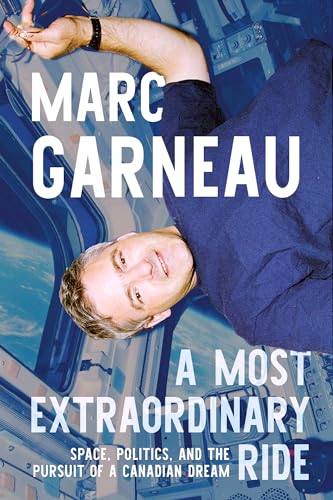


 -- First reading (hardcover)